
Blog
How Does a Blockchain Ledger Work? A Print Studio Example

A blockchain ledger is a record that several computers maintain using the same rules. They check proposed transactions, group accepted transactions into blocks and follow a shared procedure to agree which history to use. Each block contains a cryptographic link to the one before it, which helps reveal changes to earlier records.
Imagine a print studio with one transferable pass for the Saturday letterpress session. Ada holds the pass, P-17. Two other artists would like to use it. What happens if Ada tries to pass it to both?
Follow one pass through two transfer requests
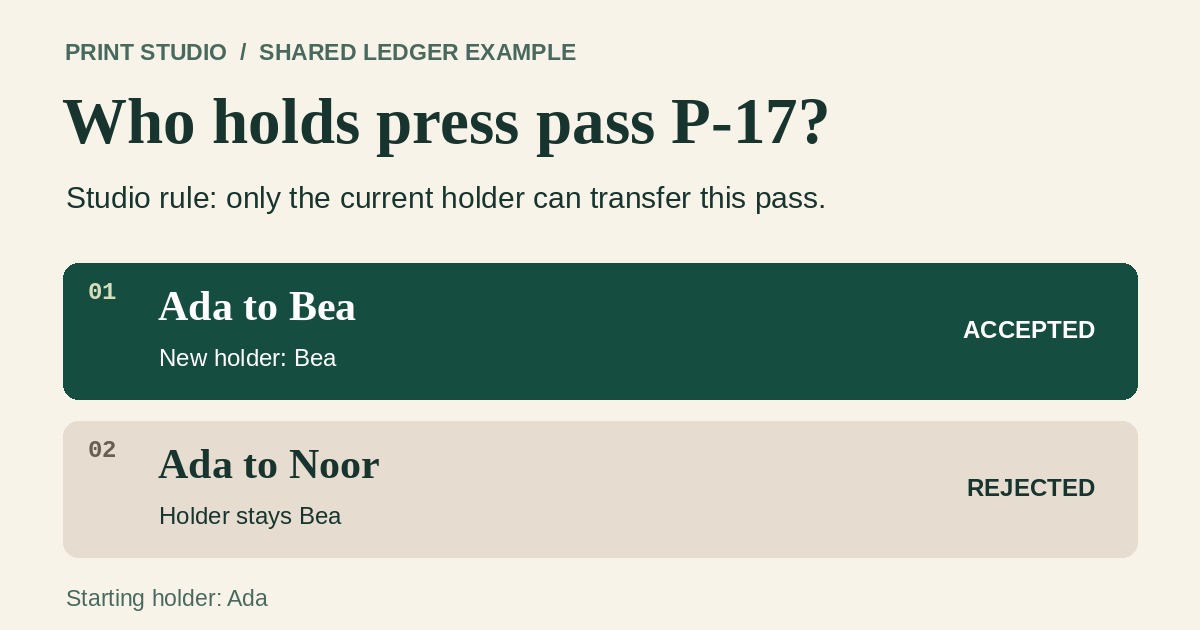
In this fictional system, only the current holder can transfer a pass. Each artist has a signing key. A transfer names the pass and the next holder. The first request below has already been accepted before the second arrives.
| Step | What happens to pass P-17? | Holder on record |
|---|---|---|
| Starting record | Ada holds P-17. | Ada |
| First request | Ada signs a transfer to Bea. It is accepted and recorded. | Bea |
| Later request | Ada signs a transfer of P-17 to Noor. It fails the holder check. | Bea |
The studio’s computers check two things separately. Does the signature match Ada’s key? Does the accepted record still name Ada as the holder? Her second request can pass the signature check and fail the holder check. Bea keeps the pass. The failed request adds no transfer of ownership to this ledger.
What makes the ledger a blockchain?
The holder rule could also run in an ordinary booking database. The blockchain part is how the participants maintain a common history. Computers on the network check entries, and the network’s consensus rules determine which chain they follow. If an old block is edited, its digital fingerprint changes. The next block’s stored reference then reveals the mismatch. The NIST blockchain glossary describes how blocks are linked and copied across the network.
Does the entry prove who used the press?
On Saturday, the studio manager asks who actually turned up. The ledger can tell her that Bea held P-17. Bea might have stayed home. To establish attendance, the manager would need a separate observation, such as the instructor’s check-in. If someone typed the wrong name at the door, preserving that entry would also preserve the mistake. Section 7.3 of NIST’s Blockchain Technology Overview explains this limit of outside data.
Try it yourself. Suppose Bea now signs a transfer to Noor and it is accepted. Who holds P-17? Who used the press? You can answer the first question from the ledger: Noor. The second still calls for a check-in record. For more practice separating a record from a claim, see how to check whether information is reliable.
To trace another transaction, A Ledger in Common includes the 31-page written course How Digital Currencies Move and a two-page reader’s guide. You can work through the studio example above with a pencil and paper.