
Blog
How to Keep a Weekly Energy Diary

Pick a time you can return to for a week. Each day, write down the activity, give your energy for that activity a score and add one detail you might otherwise forget. At the end of the week, compare two entries for the same task before deciding what to try next.
What goes in an energy diary?
Start with one line. “Tuesday, 2 p.m. — packing mugs — 2 out of 5 — spent the first few minutes looking for the tray.” Use a scale you can remember: 1 means low energy for the task, 3 is in between and 5 is high. If you miss a day, leave it blank. If you remember the entry only after dinner, put down the time you actually made the note.
Download the free weekly energy diary (fillable PDF, one page). Type into the fields or print a copy. There is space for seven daily notes and two questions for your weekly review.
A seven-day example from a pottery studio
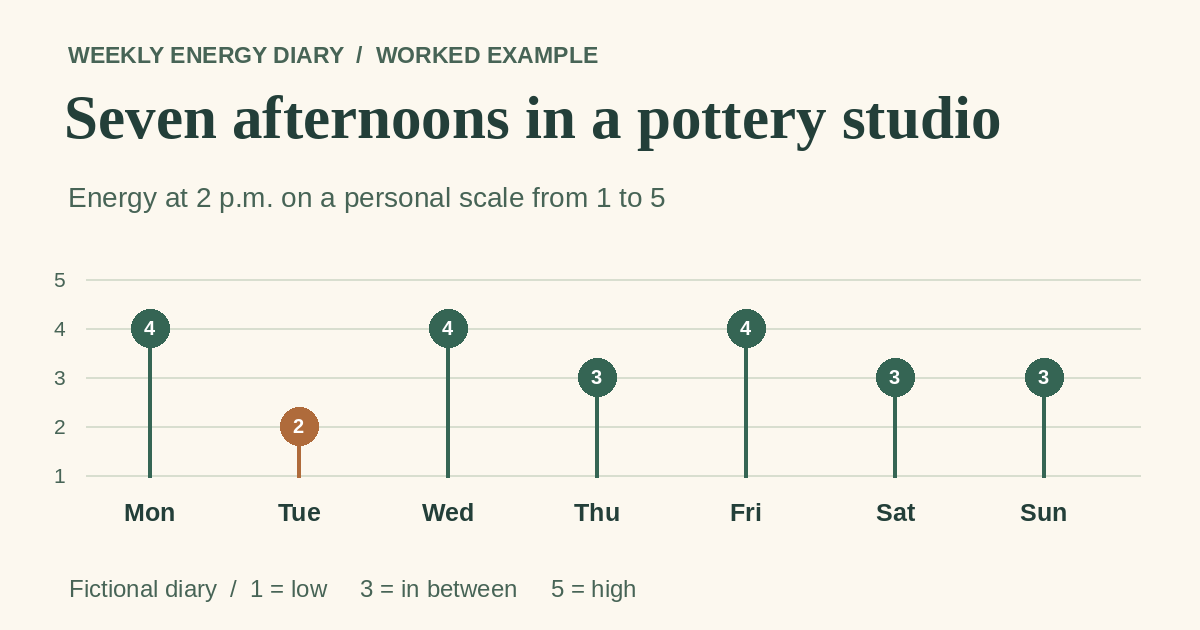
Mara runs a small pottery studio. By Friday she often remembers her week as “busy” but has forgotten which afternoons felt easy. For this fictional diary she notes what she is doing at 2 p.m. each day. All scores are her own.
| Day at 2 p.m. | Energy (1–5) | What Mara wrote down |
|---|---|---|
| Monday | 4 | Packed mugs. The tray and order list were already on the bench. |
| Tuesday | 2 | Packed mugs. Started straight after answering order messages and had to find the tray. |
| Wednesday | 4 | Packed mugs after order messages again. The tray was ready this time. |
| Thursday | 3 | Packed bowls and stopped to refill the wrapping paper. |
| Friday | 4 | Packed mugs. The tray and order list were ready. |
| Saturday | 3 | Sorted pencil sketches. The studio was closed to visitors. |
| Sunday | 3 | Read through studio notes at home. No orders to pack. |
How do you use the notes at the end of the week?
Start with Tuesday and Wednesday. Both afternoons involved messages followed by packing mugs, yet Mara gave one a 2 and the other a 4. Messages alone are a poor explanation for the difference. She also notices that the tray was ready on Wednesday and Friday. That gives her a question she can try out: does having her packing setup ready make the first few minutes easier?
For the following Tuesday, Mara decides to leave the tray and order list on the bench before lunch. She will make the same 2 p.m. note and look at it on Friday. If that afternoon is spent glazing bowls, she will mark the different task and wait for another packing day before comparing. The weekend scores stay in her diary, but she leaves them out of this particular comparison.
For your own review, finish these two sentences: “The entries I want to compare are ___ and ___ because they both involved ___.” Then: “Next week I’ll change ___ on ___ and look back on ___.”
Which workbook fits the question you want to explore?
For more guided observations, The Energy Diary includes a 13-page workbook and a separate weekly checklist. If the question is when to schedule a demanding task, Room for Rest includes the 24-page guide Map the Rhythm of Your Day. For a wider look at what you would choose to repeat in a week, A Week Well Spent includes a 15-minute Sunday review.