Blog
How to Open a B2B Cold Call: A 30-Second Script Example

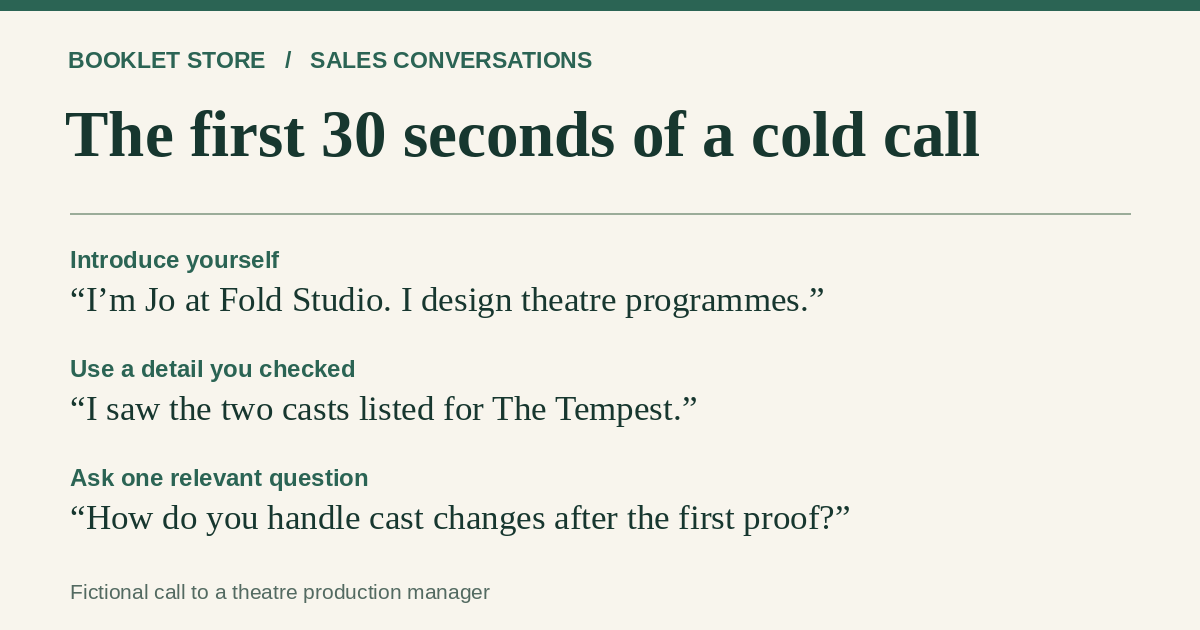
Open a cold call by saying who you are, what you do and why you chose this person. Use one detail you could point to if asked. Then ask a question the person can answer from experience. Thirty seconds is a rehearsal target. If the buyer answers sooner, let them speak.
What does a 30-second cold call opener sound like?
Jo designs printed theatre programmes. The website of a fictional theatre lists two casts for The Tempest. It does not say who edits the programme or whether late changes cause trouble. Jo calls the production manager, Maya.
Jo: “Hi Maya, I’m Jo at Fold Studio. I design theatre programmes. I saw the two casts listed for The Tempest. Have you got a moment for one question?”
If Maya says yes: “How do you handle cast changes after the first proof?”
Read the two lines aloud with a pause between them. Jo can stand behind the observation about the casts. She leaves it to Maya to say how the theatre works. If Maya asks why Jo wants to know, there is a plain answer: “I lay out cast inserts that theatres can update separately from the rest of a programme. I wondered whether that would be useful for this production.”
What if the buyer already has a supplier or asks for an email?
“Our printer handles that.” Jo could say, “Sounds like you have it covered. Thanks for letting me know.” If Maya volunteers that edits are still a headache, Jo can follow her lead: “Which part takes the most time?” A supplier relationship on its own is no reason to press for a meeting.
“Could you email me something?” Jo could ask, “Would a one-page cast insert help, or did you want to see a complete programme?” If Maya chooses the insert, Jo can offer to send that one sample. If Maya says she is busy or declines, Jo can thank her and end the call.
What should go in the call notes?
Suppose Maya says, “Email me the insert today and I’ll show it to our printer.” Jo writes down the item, owner and timing: “Jo to send one cast-insert sample today. Maya plans to share it with the printer. No follow-up date agreed.” That last line matters. Someone reading the note tomorrow can see whether a second call was actually invited.
Use the meeting notes and follow-up email example to practise separating a promise from a suggestion. For a longer sales pipeline exercise, The Next Sales Call includes a guide to recording the next action and who will take it.
What do you email after a buyer asks for a sample?
Maya wants something she can forward to her printer. Jo names the attachment in the subject and points out the detail the printer needs to see.
Subject: Cast insert sample for The Tempest
Hi Maya,
Here’s the one-page cast insert I promised. The cast list sits on its own sheet, so your printer can swap it without changing the rest of the programme. Feel free to pass the sample along.
Thanks,
Jo
The attachment fulfils the promise Jo made on the phone. If you haven’t spoken to the buyer yet, see the first cold email example for a way to ask whether they would like a sample.
Draft an opening for your own call
Write one sentence for each prompt: What do I actually do? What did I notice about this organisation? What would I like to understand? Now read the lines aloud. If your “observation” is a guess about lost revenue, delays or unhappy customers, replace it with the detail you actually found.
For a guided draft, open page 5 of The First Thirty Seconds of a Cold Call in At the End of the Call. The 15-page guide gives a structure for connecting a researched detail to the value you offer. For practice listening to a buyer’s hesitation, Across the Table includes a separate guide and a rehearsal course.