
Blog
How to Write an Ad Test Hypothesis: A Worked Example

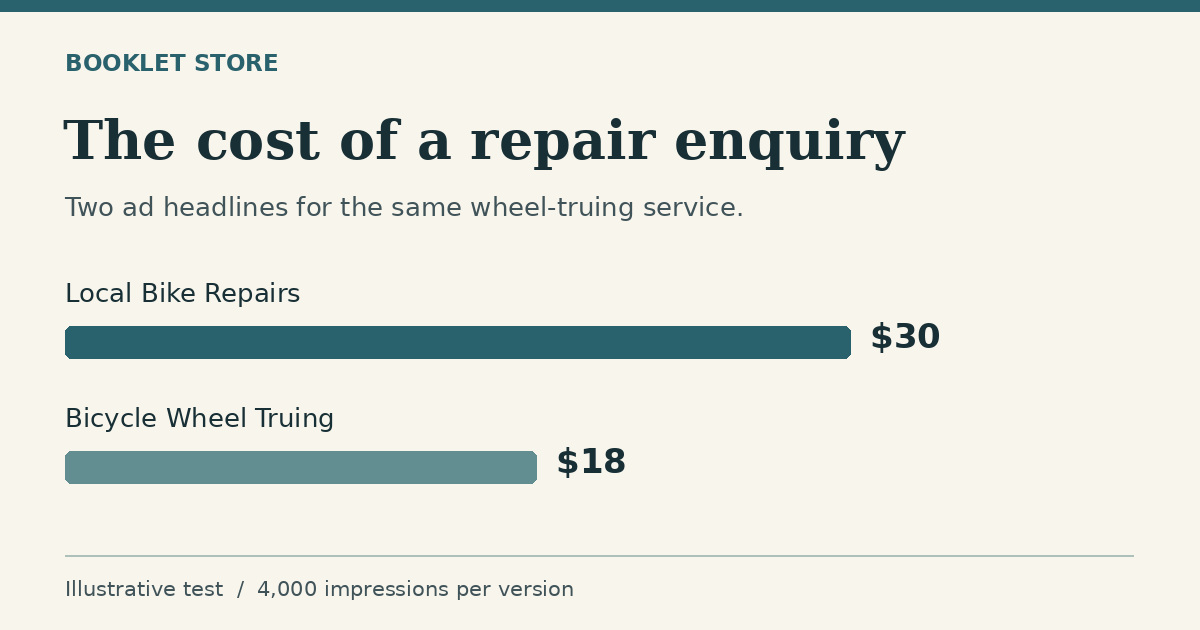
A bike shop has one repair bench and wants more wheel-truing work. Its current ad says “Local Bike Repairs.” A mechanic suggests “Bicycle Wheel Truing” so riders can recognise the service before they click. What would persuade the shop to keep the new headline? Write that down while both versions are still on the drawing board.
Planning a test with a colleague? Use the one-page ad test brief (fillable PDF) to agree on the change, data source and stopping rule. For a headline comparison that also needs separate counts and a named owner for the next action, use the detailed test record at the end.
What does a completed ad test brief look like?
Hypothesis. If the headline names wheel truing, the shop will spend less for each unique wheel-truing enquiry because more of the riders who click will already know which service the shop offers. Count each rider once, even if they send a form and then call about the same wheel.
| Decision to record | Bike shop’s entry |
|---|---|
| Current headline | Local Bike Repairs |
| Headline to try | Bicycle Wheel Truing |
| What stays the same | Audience, offer, landing page, call to action and bidding settings. |
| How to compare | Run the two versions concurrently in a controlled split. Give both groups the same opportunity to see the ad. |
| Primary measure | Ad spend divided by the number of unique, relevant repair enquiries. |
| Supporting measures | Clicks per impression and the number of clicks that turn into relevant enquiries. |
| Before launch | Send one test enquiry through each route. Confirm it reaches the shop and can be matched to the version that brought it in. Exclude those checks from the results. |
For a checklist you can use to plan your own comparison, One Test on Record includes Before the Test Goes Live. Its opening section asks for the current situation, the change, the expected outcome and how you will measure it.
Which headline would you keep?
Suppose these are the figures at an agreed review point. All numbers are fictional. The shop has checked its enquiry log for duplicates and given both groups the same time for responses to arrive.
| Measure | Local Bike Repairs | Bicycle Wheel Truing |
|---|---|---|
| Impressions | 4,000 | 4,000 |
| Clicks | 160 | 120 |
| Click-through rate | 4% | 3% |
| Ad spend | $240 | $216 |
| Unique wheel-truing enquiries | 8 | 12 |
| Cost per relevant enquiry | $30 | $18 |
The general headline drew 40 more clicks. The specific headline brought in four more relevant enquiries on $24 less spend. Dividing $216 by 12 gives $18 per enquiry, compared with $240 divided by 8, or $30. That is the outcome the shop decided to measure before launch.
The figures favour the specific headline at this checkpoint. With only eight and twelve enquiries, chance could still explain the gap. Check the uncertainty reported for the primary outcome where available, the planned sample size and whether enquiries are still arriving. If the test ends without enough evidence, record it as inconclusive. If form totals include unrelated jobs, reconcile them with the shop log before drawing a conclusion.
An enquiry can still end without a booking. Follow the shop example that traces forms through to paid repairs if completed work is the outcome you need.
For a second worked comparison, see what happens when cheaper leads turn into more expensive paid repairs. It follows both versions through to the invoice and uses the same observation window for every enquiry.
What should you write when an ad test is inconclusive?
Suppose the bike shop agreed to run the ads from 1 to 14 June and allow another seven days for enquiries to arrive. Before launch it set a minimum of 25 unique relevant enquiries per version before considering a switch. That number is an illustrative review rule for this shop. Reaching it would trigger a review of the uncertainty around the difference. It would not, on its own, establish a winner.
Observation. A cost $240 for eight enquiries, or $30 each. B cost $216 for twelve enquiries, or $18 each. B’s observed cost was $12 lower per enquiry, a 40% reduction relative to A.
Decision. “Closed as inconclusive. Neither version reached 25 enquiries by the agreed deadline. Keep A in place and hold the current budget.” A future reader can now see why the lower figure did not trigger a rollout.
Next action. “Jo will check unmatched calls against the enquiry log by 23 June and record any corrections.” If a call is linked later, keep the original counts alongside the revision and note whether the decision changes.
Download the completed one-page test record (PDF) to see all 13 fields together. Use the blank record below when you run your own comparison.
A one-sentence template for your next test
“If we change ___ to ___ for ___, we expect ___ to change because ___. We will measure it by ___.” Underneath, write what stays the same, how you will check the measurement and when you will review the result. Set the review plan using your usual traffic, the smallest difference worth acting on and the time customers typically take to respond.
For a follow-up checklist, One Change at a Time includes Review a Winner before Scaling. For the platform’s guidance on choosing a hypothesis and isolating a change, see Google Ads experiment best practices.
Download the one-page, fillable ad test record (PDF). Enter the hypothesis and decision rule before launch. After the test, add the counts for each version, the decision and the person responsible for the next action.