
Blog
Equivalent Fractions Lesson Plan for Grade 3

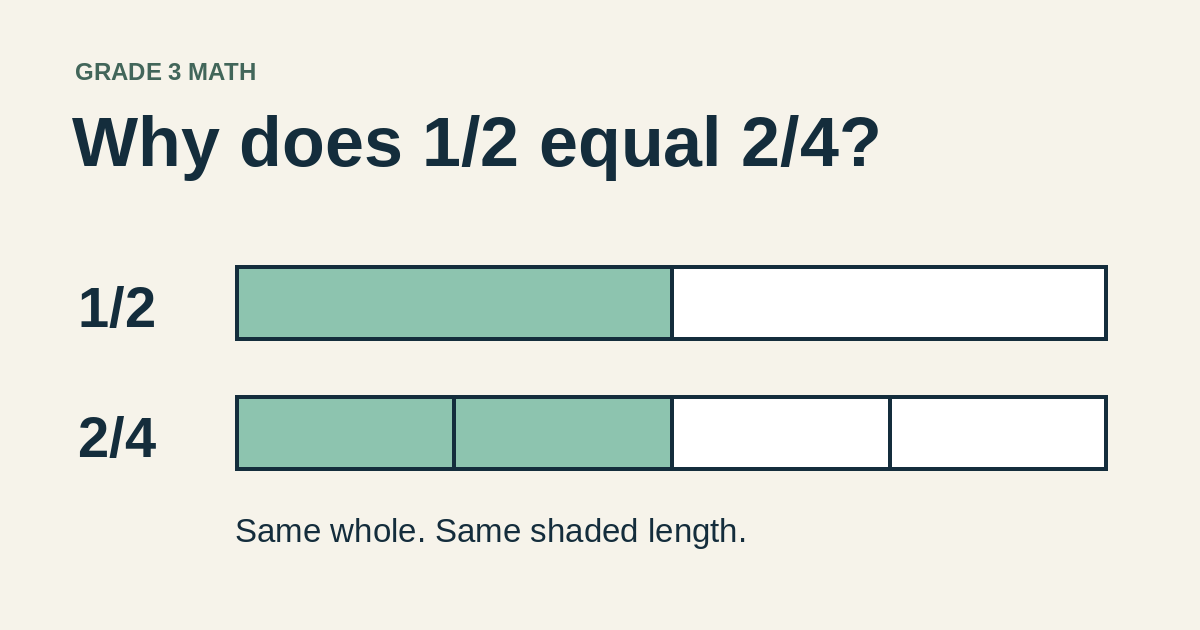
Ask the class, “Would you rather have one half of a sandwich or two fourths?” Someone may choose two fourths because two pieces sound like more lunch. Draw two sandwiches of the same size. When you cut one half into two equal pieces, you have two fourths. You still have the same amount of sandwich.
Learning goal. By the end of this 25-minute lesson, each student can use two equal-length paper strips to show why two fractions are equivalent and explain what stayed the same when the pieces got smaller. Students should already know how to divide a whole into equal parts and name a half, a third and a fourth.
Print the one-page fraction strip worksheet (PDF), one per student. For the demonstration, bring two blank paper strips of the same length and width. Students need a pencil or crayon.
A 25-minute lesson with fraction strips
0–4 minutes · Make a prediction. Ask the sandwich question before showing any shaded strips. Have students choose an answer, then ask, “What would you need to know about the two sandwiches?” Align the ends of your two blank strips to establish that each represents the same whole.
4–9 minutes · Model one half and two fourths. Fold the first strip in half and shade the left half. Fold the second strip in half and in half again. Open it and shade the first two fourths. Lay the strips one above the other with their left edges aligned. Ask a student to point to the end of each shaded part. Students shade the first pair on their worksheet and record what they notice.
9–17 minutes · Work in pairs. On the second pair of strips, one partner shades one third. The other shades two sixths. Ask, “How many sixths fit inside the first third? Where would the new fold go?” Have partners switch roles so the student who shaded the thirds explains the sixths.
17–21 minutes · Test a claim. Write, “Two fourths is more because it has two shaded pieces.” Give partners a minute to convince the speaker using only their strips. Listen for a reference to piece size. A student might say, “Each green piece on the second strip is smaller. It takes two of them to reach the end of the first green piece.”
21–25 minutes · Collect an exit ticket. Ask students to complete the third pair on their own. They shade two thirds and four sixths, then write or dictate one sentence explaining why the shaded lengths match.
What counts as an explanation?
Exit ticket answer. “I split each third into two equal pieces. That gave me sixths. The two thirds I shaded now cover four sixths. The strips are the same length and both shaded parts stop in the same place.” A student who explains the same idea in their own words has met the goal.
If a student writes only “2/3 = 4/6,” cover the fraction labels and ask them to point to the two sixths inside one third. If their shaded lengths differ, first check that the strips start together and that they shaded from the same end.
How to check an AI-generated lesson plan
To adapt the lesson before class, try this prompt: “I teach Grade 3. My students can name halves, thirds and fourths. I have 25 minutes, paper strips and pencils. Draft one partner activity where students explain why fractions are equivalent. Give me one likely wrong answer, a question I can ask in response and an independent exit ticket. Flag anything you assume about what students already know.”
Read the proposed exit ticket first. “Shade half a rectangle” checks whether a child can represent one fraction. To assess equivalence, ask for a second representation of the same amount and a reason the two match. Then check whether the proposed activity gives students time to practice that explanation.
For planning another lesson, the Tomorrow’s Lesson bundle includes the 30-page Draft a Lesson in Five Steps guide and a separate six-page checklist for reviewing an AI-generated plan. The worksheet above is a free companion to this article.
This lesson practices explaining equivalent fractions with a visual model, a skill described in Common Core math standard 3.NF.A.3b.