
Blog
How to Run a Small Business Time Audit

A small business time audit starts with one question you can answer from a log. For the owner of a picture-framing shop, the question is “Why is the new price list still unfinished when I set aside the first hour every morning?” Five mornings are enough to test what happened to those particular hours.
Choose one part of the week to track
In this worked example, the owner records what happens between 9 and 10 a.m. for five weekdays. Each time the task changes, she writes down the time, what she did and what prompted the switch. She labels each entry as pricing, order updates, or measuring and quotes. If she talks to a customer while the price list is open, those minutes go under the customer task. This keeps each minute in a single category.
A line you can copy: [Start–end] | [What I did] | [What prompted the switch] | [Who needed to handle it?]
Monday, 9:00–9:15. Compared the new moulding costs with the old prices. 9:15–9:40. Looked up collection dates after customers asked about existing orders. 9:40–10:00. Measured a print and priced the frame for a walk-in customer.
Add up the five opening hours
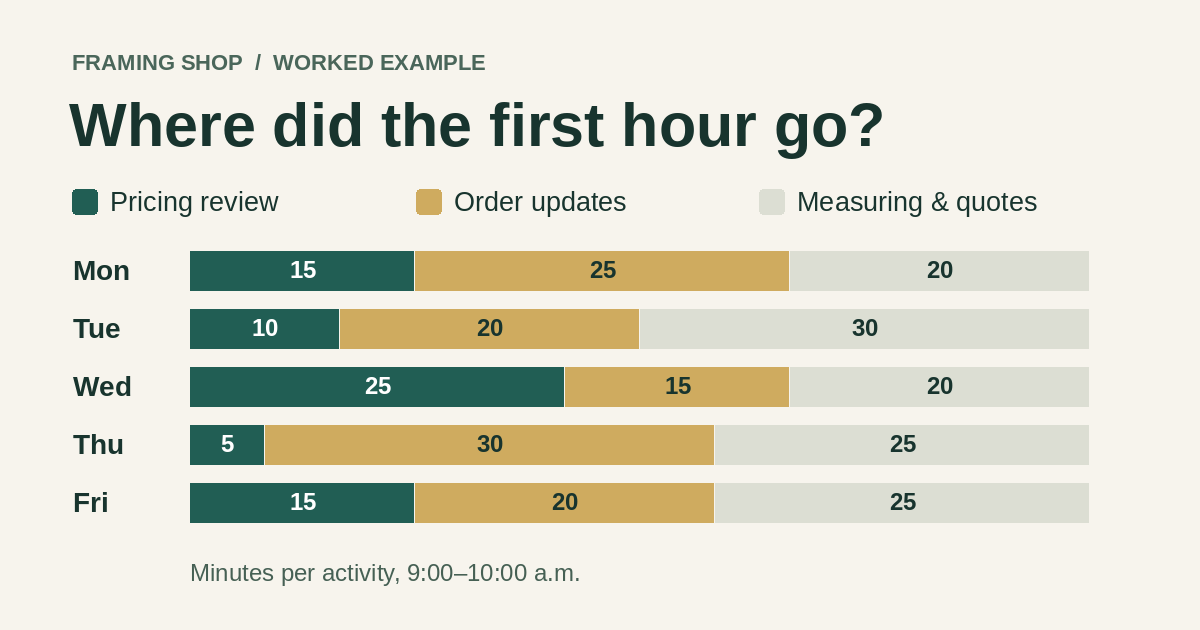
These are illustrative figures for the first hour of each day. They add up to 300 minutes.
| Day | Pricing review (min) | Order updates (min) | Measuring and quotes (min) |
|---|---|---|---|
| Monday | 15 | 25 | 20 |
| Tuesday | 10 | 20 | 30 |
| Wednesday | 25 | 15 | 20 |
| Thursday | 5 | 30 | 25 |
| Friday | 15 | 20 | 25 |
| Total | 70 | 110 | 120 |
The pricing review received 70 of the 300 minutes. Measuring and quotes took the largest share, 120 minutes, but those customers brought in new work. The owner chooses to look more closely at the 110 minutes spent on existing orders. A colleague can look up a confirmed collection date. A promise to finish a frame earlier still needs the owner’s decision.
Try one change and check the result
For next Thursday, the owner reserves 9:00–9:45 to update the prices of three standard frames. Before the shop opens, she gives her colleague the collection list and confirms who will handle walk-ins. The colleague can answer routine status questions and will interrupt if a customer is there to collect a frame that cannot be found. If nobody can cover the counter, the owner moves the block to a staffed period.
After the session, she records how many of the three prices she updated, how many minutes she spent on pricing and whether any customer missed a promised reply. Last Thursday she managed five minutes of pricing. The next Thursday’s figures will show whether the change earned another trial.
For a calendar entry with space for interruptions and a restart note, use the 45-minute time-blocking example. To work through your own week, The Hour You Keep includes the 32-page Trace Where Your Week Goes guide and the separate six-page Protect an Owner’s Working Hour checklist.