
Blog
Cost per Lead vs. Cost per Paid Job: A Worked Example

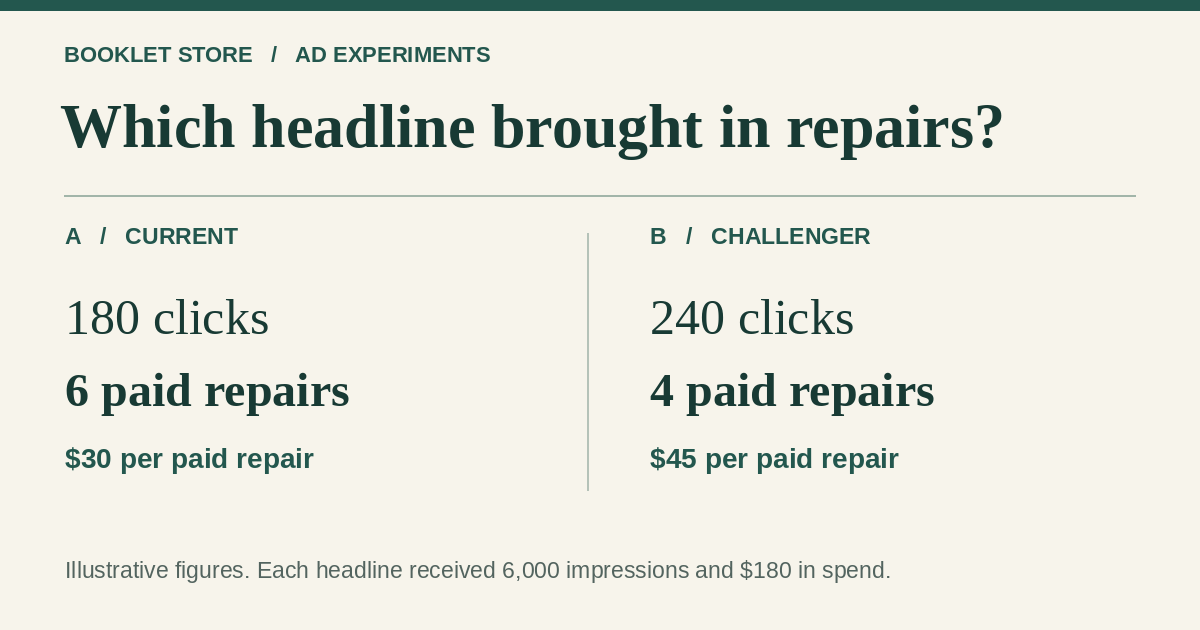
Cost per lead is ad spend divided by unique leads. Cost per paid job is the same spend divided by completed jobs the customer paid for. A headline can bring in cheaper enquiries while costing more for each job that reaches the till. A bike repair shop’s figures show how that happens.
Decide what counts as a lead and a paid job
Suppose the shop is comparing “Local Wheel Truing” with “Wheel Wobbling?” Both ads lead to the same repair request form. The mechanic wants paid wheel-truing work. A request from a rider about that service counts as one relevant lead, even if the rider follows their form submission with a call. A paid invoice for that repair counts as one job.
The shop gives each enquiry 30 days to become a paid job. Before comparing the ads, the owner waits until even the most recent enquiry has had those 30 days. An untraceable invoice stays in a separate “source unknown” group. This comparison uses fictional figures and a window chosen for this shop.
Compare the same spend at each stage
| Measure | A · Local Wheel Truing | B · Wheel Wobbling? |
|---|---|---|
| Impressions | 6,000 | 6,000 |
| Clicks | 180 | 240 |
| Ad spend | $180 | $180 |
| Unique relevant enquiries | 9 | 15 |
| Cost per lead | $20 | $12 |
| Completed, paid repairs | 6 | 4 |
| Share of leads that became paid jobs | 66.7% | 26.7% |
| Cost per paid job | $30 | $45 |
For headline B, $180 ÷ 15 enquiries gives $12 per lead. Only four of those enquiries became paid repairs, so $180 ÷ 4 gives $45 per paid job. For A, $180 ÷ 9 gives $20 per lead and $180 ÷ 6 gives $30 per paid job. Both calculations use the same spend and observation window.
You can also recover the second cost from the first. Divide cost per lead by the fraction of leads that became paid jobs. For B, $12 ÷ (4/15) = $45. Use the original counts in the calculation and round only the displayed result.
How do you report cost per paid job when no jobs have been paid?
Suppose a third ad spends $90 and brings in five relevant enquiries. After the same 30-day follow-up window, none has a paid invoice. Cost per lead is $90 ÷ 5 = $18. The share of those leads that became paid jobs is 0/5 = 0%. Cost per paid job is undefined because its denominator is zero.
Report row: $90 spend · 5 enquiries · 0 paid jobs · $18 per lead · cost per paid job: N/A. Keep the spend and the zero job count visible. Entering $0 per paid job would make this version look as though it acquired customers for free.
If some enquiries are still inside their 30-day window, label that row “awaiting follow-up” and give it a review date. Once the window closes, reconcile those enquiries with the invoice log before recording the final counts.
How to match an enquiry to a paid repair
Give the enquiry a reference when it reaches the shop. Keep the ad version, enquiry date and job status with that reference. When the mechanic closes the repair, match the paid invoice to it. Suppose reference R-014 began as a form submission and the rider called the next morning. Link both contacts to R-014. If the wheel was collected and the invoice paid on day nine, that is one lead and one paid job for its original ad version.
An open estimate has earned its place in the lead count. It can enter the paid-job count when payment arrives within the agreed window. The form-to-invoice example shows how repeat submissions affect the calculation.
What would you change after seeing these numbers?
B brought in six more relevant enquiries at the same spend, yet A produced two more paid jobs. With just ten paid repairs in total, a couple of jobs could change the conclusion. The owner keeps the current headline while checking the unmatched invoices and the reasons estimates stayed open. The table alone cannot tell the owner why the two groups converted differently.
If some repairs take more time or parts, compare the amount left from each job after those costs before increasing spend. If the next test is about enquiries, use the completed headline-test brief to define a relevant lead before launch. If paid work is the goal, put paid jobs and the follow-up window on the first line of the fillable ad test record.
For a guided review, The Ad Spend Review covers campaign tracking and return. One Test on Record includes separate guides for planning an experiment and reading its results.