
Blog
How to Calculate Contribution Margin per Order

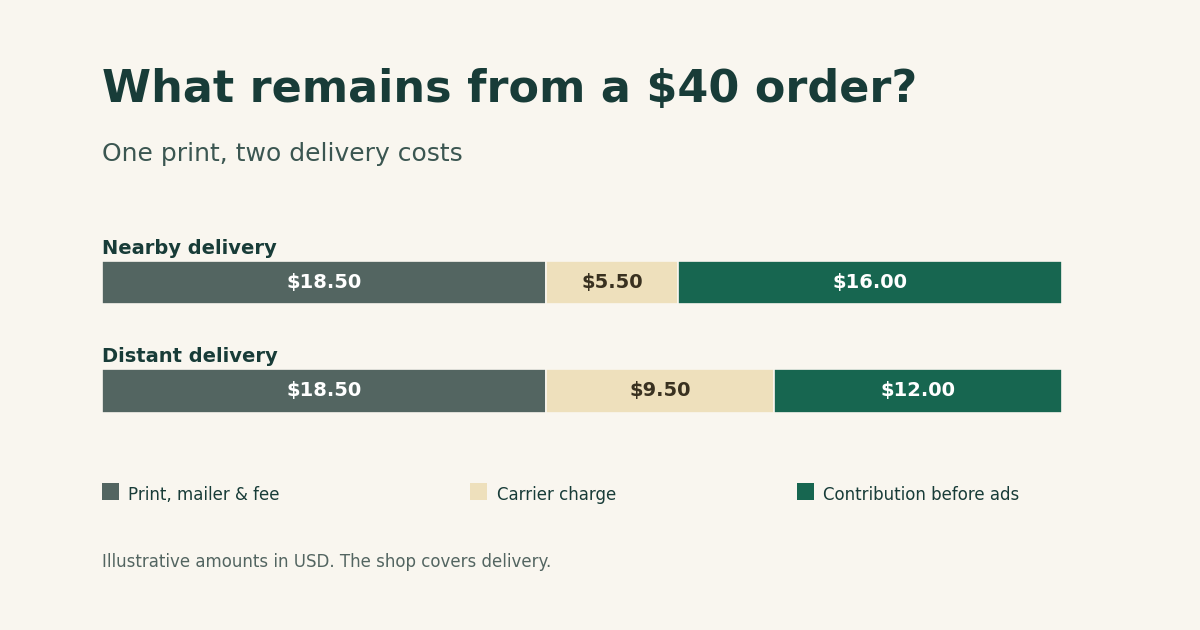
Two customers buy the same $40 art print with delivery included. One order leaves the shop $16 before advertising and fixed costs. The other leaves $12. The only difference is the carrier’s charge. Here’s how to find that difference in your own order records.
How much does each $40 order contribute?
Subtract the costs that arise from fulfilling the order from its net revenue. Divide the remainder by net revenue to express it as a percentage. The examples below use fictional orders, assume no discounts or refunds, and exclude sales tax. The processing fee is an illustrative amount.
| Per order (USD) | Nearby delivery | Distant delivery |
|---|---|---|
| Customer payment for the print | $40.00 | $40.00 |
| Print production | $15.00 | $15.00 |
| Protective mailer | $2.00 | $2.00 |
| Payment processing | $1.50 | $1.50 |
| Carrier charge paid by the shop | $5.50 | $9.50 |
| Total variable costs before ads | $24.00 | $28.00 |
| Contribution before ads | $16.00 | $12.00 |
| Contribution as a share of revenue | 40% | 30% |
For the nearby order, $40 − $15 − $2 − $1.50 − $5.50 leaves $16. For the distant order, the carrier charges $4 more, so $12 remains. A weekly sales report would show $80 of revenue across these two orders. Together, they contributed $28 before ads, or 35% of the $80.
How many extra orders would a 10% discount take?
Suppose the shop usually sells 30 prints for nearby delivery in a week. At $40 each, those orders contribute 30 × $16 = $480 before ads and fixed costs. A 10% discount brings the price down to $36. If each order still costs $24 to fulfil, including the same $1.50 processing fee for this example, each discounted order contributes $12.
To reach the same $480, the shop would need $480 ÷ $12 = 40 orders. That’s ten extra orders, or about a third more than usual. Even 35 sales would leave it short: revenue would rise from $1,200 to $1,260, but the prints would contribute only $420.
To try this with your own promotion, divide your usual total contribution by the contribution from one discounted order and round up to a whole order. Use the fees and delivery costs you expect during the sale. If each discounted sale leaves zero or less, selling more at that price cannot recover a positive contribution target. The What the Price Includes Bundle includes a 17-page guide for planning a discount.
Where do you find the numbers for your own order?
Choose a fulfilled order and open its order confirmation, payment transaction and shipping label receipt. Use the product price after any discount. Add shipping revenue if the customer paid for delivery separately. Enter the actual carrier charge on the cost side, even when the checkout showed free shipping. If you start from a payout that already has the processing fee deducted, avoid subtracting it a second time.
Add the cost of the units you shipped and the packaging you used. If the order triggered another cost, such as a per-order fulfillment fee, include that too. Keep the same list of cost categories when comparing two orders. A monthly storefront subscription belongs in your fixed-cost review.
What can you decide from the difference?
The $4 gap tells this shop which cost to examine. Before changing the price of every print, it can check recent carrier receipts to see how many parcels incurred the higher charge. If it spends $10 acquiring each of these two orders, the amounts left toward fixed costs become $6 and $2. Profit for the period also depends on fixed costs and the rest of the shop’s sales.
For the accounting definition, see OpenStax’s contribution margin glossary. To use the amount left before ads to calculate an advertising threshold, follow the worked break-even ROAS example.
To review one of your own products, the What an Order Leaves Bundle includes the 16-page Trace the Margin on a Product guide and a five-page checklist for reviewing margins across the shop.